
Driving Data Rollover adoption for by.U’s customers
As part of the by.U platform migration, improving feature discoverability and understanding of new offered products as part of an updated launch value prop was critical within a complex, modular telco offering.
This case focuses on simplifying the awareness layer of power-up products and driving Rollover adoption.
Overview
This initiative focused on improving how users discover and understand new “Power-Up” data packages within the by.U app.
The experience follows a three-stage funnel:
Awareness → Consideration → Purchase
Success metric:
Increase user understanding → consideration → conversion of these new Power-up packages
Approach
Iteration 1: Broad Exposure
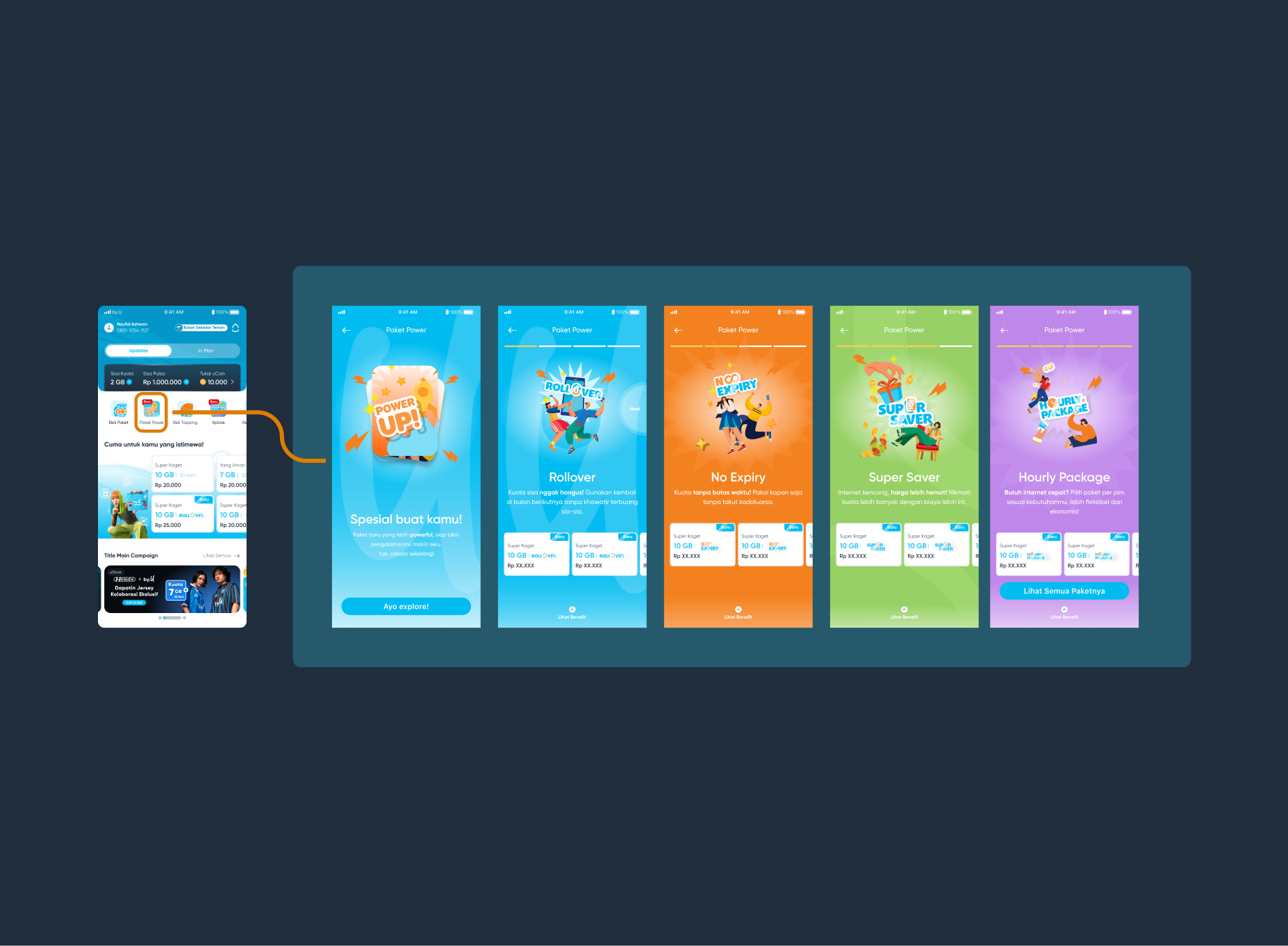
Initial exploration introduced multiple power-up data packages (Rollover, No Expiry plans, Super Saver, Hourly packages). We did this by exposing all power-ups upfront to educate users.
What we tested:
Can users distinguish between the different power-up products?
Can users identify which to choose?
Results:
❌ Low comprehension rate → Users unclear how power-ups differ
❌ Misinterpreted product model → Assumed packages were related/bundled
❌ High cognitive load → Too many options at entry point
❌ Low decision confidence → Hesitation to proceed to purchase
👉 Insight: More exposure ≠ better understanding
👉 Impact: Drop-off risk at awareness → weak conversion downstream
Strategic Pivot: Focus & Simplify
We shifted from “feature set completeness” → “decision clarity”
Key decisions:
Prioritise Rollover as primary product with alignment from our business team and the client
Defer other power-ups to later stages
Design for progressive disclosure
Why data Rollover (data-backed):
Highest user resonance in FGD
Strongest perceived value (unused data recovery)
Highest potential conversion leverage
👉 Hypothesis: Reducing options will increase comprehension and decision speed
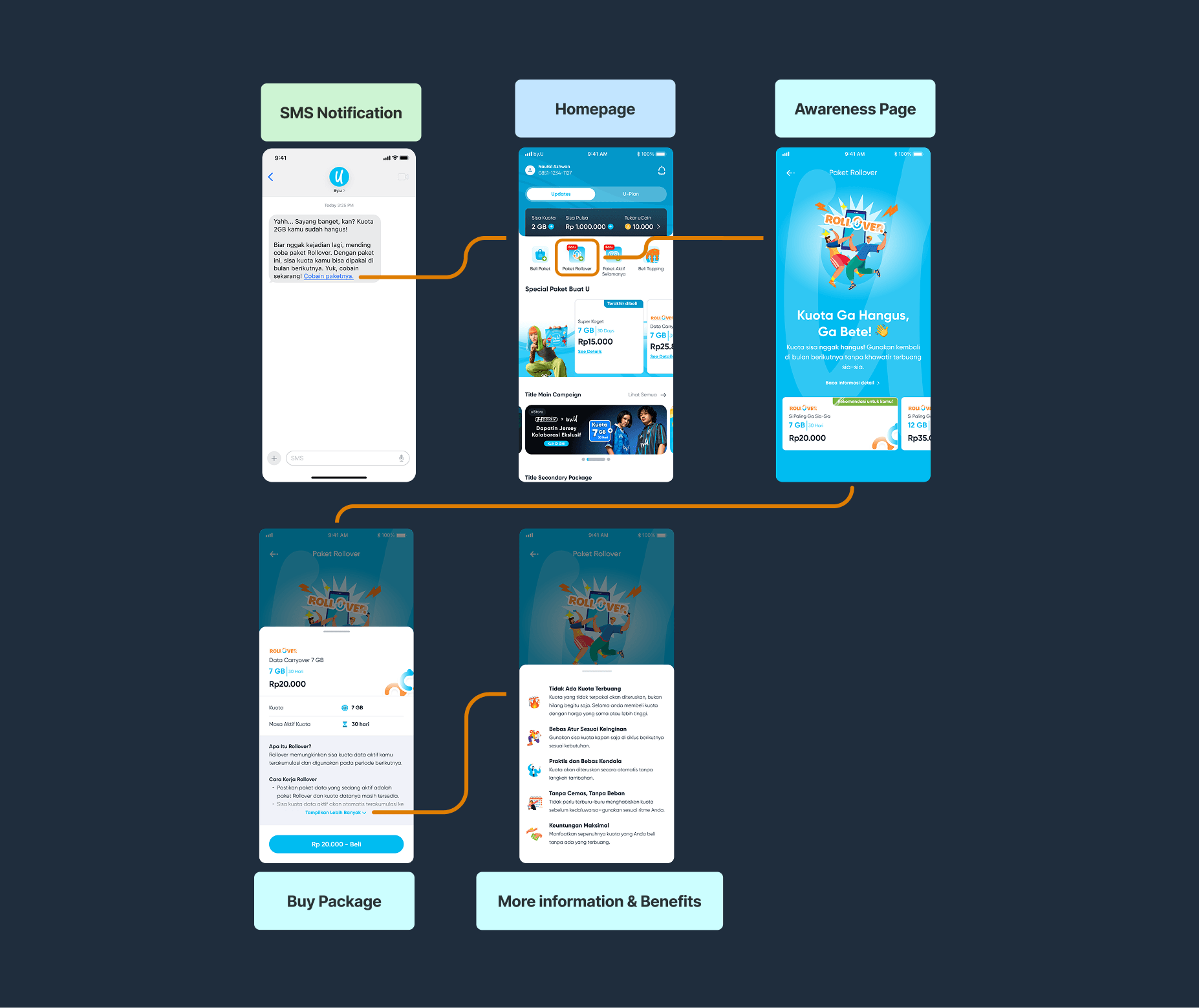
Iteration 2: Rollover as a Champion
We redesigned the flow to optimise for clarity and action:
Dedicated awareness entry point
Clear benefit-first messaging
Simplified information hierarchy
In-category comparison (within Rollover only)
Improved CTA visibility and placement
Leveraged existing catalog for scalability
Testing Goal
Measure improvement across:
Findability → Can users locate Rollover easily?
Comprehension → Do users understand how these products work?
Decision readiness → Are users willing to purchase?
Outcome
Quantitative
SEQ: 6.8 / 7 (High usability)
→ Users found the flow easy to completeTask success: High
→ Majority completed key journey without assistance
Qualitative (Behavioural Signals)
Post-iteration users were able to:
✅ Accurately explain how Rollover works
✅ Identify key benefits (no wasted data, flexibility)
✅ Compare packages and select confidently
✅ Show stronger purchase intent signals
Impact (Framed for Product)
↓ Cognitive Load → Fewer choices, clearer path
↑ Feature Comprehension → Correct mental model formed
↑ Decision Confidence → Reduced hesitation
↑ Conversion Readiness → Stronger progression to purchase
👉 Net effect: Improved Awareness → Consideration conversion quality
Reflection
Initial approach optimized for coverage, but not clarity.
By narrowing focus to a single, high-value product, we aligned the experience with how users actually make decisions:
→ Start with value
→ Build understanding
→ Enable comparison
→ Drive action
Clarity reduces friction. Reduced friction improves conversion.